

Managing stress after amputation is an important part of adapting to life with limb loss. Recovery is not limited to healing a surgical site, learning mobility skills, or adjusting to a prosthesis. It also involves learning how to respond to uncertainty, frustration, changing routines, physical discomfort, and emotions that may appear unexpectedly.
Stress can come from many directions. A prosthetic socket may suddenly feel uncomfortable. A simple outing may require more planning than it once did. Pain or fatigue can change your plans. Questions from strangers may become tiring. Work, finances, relationships, transportation, medical appointments, and concerns about the future may add even more pressure.
None of these experiences follows a predictable timeline. Someone may feel confident for weeks and then have a difficult day after a fall, prosthetic problem, medical appointment, or unexpected reminder of what has changed. The Amputee Coalition’s emotional recovery resources recognize that adjustment after limb loss can involve grief, anxiety, trauma, and a wide range of emotional responses. (Amputee Coalition)
Managing stress does not mean eliminating every difficult emotion. It means developing practical ways to notice stress, reduce unnecessary pressure, protect your energy, and find appropriate support when you need it.
Managing Stress After Amputation: Understand Why Stress Can Feel Different
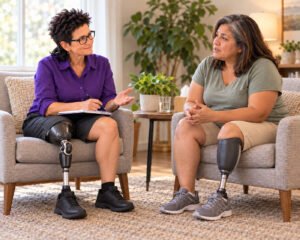
Life after amputation can require constant adjustment. Activities that once happened automatically may now involve decisions about prosthetic use, mobility aids, accessibility, skin comfort, transportation, energy, and safety.
This extra decision-making can create a mental load that other people may not see. You might find yourself wondering whether a destination has accessible parking, whether you can comfortably wear your prosthesis for several hours, whether there will be somewhere to sit, or what you will do if pain suddenly increases.
Physical concerns can also influence emotional well-being. Residual limb discomfort, phantom sensations, changes in prosthetic fit, poor sleep, fatigue, and fear of falling can make an already stressful situation more difficult.
Lifelong Prosthetics explores these broader emotional changes in Mental Health After Amputation: Coping With Grief, Anxiety, and Change, where grief, anxiety, identity, pain, mobility, and everyday adjustment are treated as interconnected parts of life after limb loss. (Lifelong Prosthetics)
Understanding where stress comes from can make it easier to respond to the actual problem instead of judging yourself for having a difficult day.
Managing Stress After Amputation: Learn to Recognize Your Personal Stress Signals
Stress does not always announce itself clearly. Sometimes it appears as irritability, tension, difficulty concentrating, disrupted sleep, withdrawing from people, feeling rushed, or becoming overwhelmed by decisions that normally seem manageable.
Your stress signals may also be connected to specific situations. You might notice increased frustration after a long day of prosthetic wear, anxiety before appointments, tension when walking somewhere unfamiliar, or emotional exhaustion after repeatedly explaining your amputation to other people.
Try observing patterns without immediately trying to fix them. Ask yourself what happened before your stress increased. Were you tired? Was your prosthesis uncomfortable? Had you skipped a meal? Were you worried about falling? Did someone cross a personal boundary?
A brief journal can help. You do not need to document every detail. A few sentences about your mood, pain, sleep, prosthetic comfort, activity level, and major stressors may reveal useful patterns over time.
Recognizing your early warning signs gives you a chance to make an adjustment before stress becomes overwhelming.
Managing Stress After Amputation by Reducing the Mental Load of Everyday Tasks
Small problems can have a surprisingly large emotional effect when they happen repeatedly.
Lifelong Prosthetics discusses this directly in Amputee Mental Health: How Small Moments Can Derail a Day. Something as ordinary as dropping an object may require much more effort when balance, prosthetic removal, mobility, pain, or limited reach is involved. Repeated frustrations can create both physical and emotional fatigue. (Lifelong Prosthetics)
One way to manage stress after amputation is to reduce unnecessary daily decisions.
Keep frequently used prosthetic supplies in predictable places. Prepare clothing or equipment before a busy morning. Keep essential items within easy reach. Allow extra time when leaving home so that a liner problem, changing residual-limb volume, or transportation delay does not immediately create pressure.
Planning also helps outside the home. Before visiting somewhere unfamiliar, consider parking, entrances, seating, restrooms, terrain, walking distance, and transportation.
A backup plan can be especially valuable. Knowing what you will do if your prosthesis becomes uncomfortable or your energy drops can reduce the feeling that everything depends on the day going perfectly.
Use Simple Techniques to Bring Yourself Back to the Present
When stress rises, the mind often moves toward everything that could go wrong. You may start thinking about future surgeries, falls, finances, work, prosthetic problems, relationships, or whether you will regain a particular ability.
You do not have to solve every future concern at once.
Simple grounding practices can help redirect attention toward what is happening now. Slow your breathing. Notice where your body is supported. Identify sounds around you. Relax your jaw and shoulders if possible. Ask yourself what the next manageable action is rather than trying to solve the entire situation.
The CDC’s guidance on managing stress includes approaches such as breathing exercises, stretching, journaling, spending time outdoors, relaxation, and making time for activities you enjoy. (CDC)
These strategies are not meant to pretend that a difficult situation is easy. Their purpose is to create enough mental space to decide what you need next.
The Amputee Daily Wellness Method™ takes a similar flexible approach by focusing on manageable actions that support physical, emotional, relational, and everyday well-being rather than expecting a perfect day. (Lifelong Prosthetics)
Protect Sleep, Energy, and Physical Comfort
Emotional balance becomes harder when your body is already exhausted.
Living with limb loss may require additional physical effort throughout the day. Transfers, walking, wheelchair mobility, prosthetic management, skin care, appointments, and everyday activities can all use energy.
Instead of waiting until you are completely exhausted, build recovery time into your schedule. Alternate demanding activities with lighter ones when possible. Sit for tasks that do not need to be completed standing. Allow yourself to modify plans when pain, skin problems, poor sleep, or unusual fatigue changes what is realistic.
The National Institute of Mental Health includes regular activity, sleep, relaxation, setting priorities, and staying connected among strategies that can support mental health. Activities should always be adapted to your individual health and abilities. (National Institute of Mental Health)
For more limb-loss-specific guidance, Lifelong Prosthetics’ Daily Self-Care for Amputees explains how monitoring pain, energy, mobility, skin, and prosthetic comfort can help make daily routines more sustainable. (Lifelong Prosthetics)
Rest is not wasted time. Sometimes it is the action that allows everything else to remain possible.
Stay Connected While Protecting Your Boundaries
Stress often becomes heavier when you feel that you have to carry it privately.
Talking with someone you trust can help, but useful support is personal. Some days you may want advice. Other days you may simply want someone to listen without trying to solve anything.
Be specific when you can. You might tell a family member that you need help with transportation but want to manage your prosthesis independently. You might ask a friend to listen rather than offer suggestions. You might explain that you do not want to discuss your amputation during a social event.
Boundaries are also part of emotional balance. You do not have to answer every question about your body, explain your mobility choices, or accept assistance you do not want.
Peer support can offer a different kind of connection because another person with limb loss may understand some experiences without requiring a lengthy explanation. The Veterans Health Library notes that peer counselors who have experienced amputation can help answer questions about life after surgery and provide shared perspective. (Veterans Health Library)
Connection should make your world feel more supportive, not take away your control.
Build Confidence Through Small and Flexible Goals
Large goals can become stressful when every day is measured against them.
Instead of asking whether you have completely returned to independence, work, exercise, travel, or prosthetic use, focus on smaller actions that are possible now.
You might practice one transfer, make one phone call, attend part of a social event, organize your prosthetic supplies, prepare a meal while seated, walk a manageable distance, or ask a provider one important question.
Small goals provide useful information. If something works, you can build from it. If it does not, you can change the environment, equipment, timing, or support rather than deciding that you failed.
Confidence after limb loss does not require fear to disappear. As Lifelong Prosthetics explains in Building Confidence After Limb Loss: Identity, Relationships, and Support, confidence can involve preparation, asking for assistance, setting boundaries, adapting activities, and making choices that reflect your actual needs. (Lifelong Prosthetics)
Your goals can change as your body, health, priorities, and circumstances change. Flexibility is not abandoning progress. It is part of making progress sustainable.
Know When Additional Support May Be Helpful
Self-care strategies can be valuable, but they are not expected to solve every form of stress.
Consider speaking with a qualified healthcare or mental health professional if anxiety, sadness, irritability, hopelessness, fear, sleep problems, withdrawal, or loss of interest continue, become difficult to manage, or interfere significantly with daily activities, relationships, rehabilitation, or self-care. NIMH recommends seeking professional help when distressing symptoms persist or make everyday functioning difficult. (National Institute of Mental Health)
Physical concerns should also be addressed appropriately. Persistent prosthetic discomfort, skin breakdown, unexplained pain, significant mobility changes, or other medical symptoms deserve assessment rather than being treated only as emotional stress.
Different professionals provide different forms of support. Your physician, prosthetist, physical or occupational therapist, rehabilitation team, and licensed mental health professional may each address different parts of the problem.
Practical, non-clinical guidance can also have a place. Lifelong Prosthetics provides amputee coaching and support focused on education, communication, self-advocacy, prosthetic questions, and navigating everyday life with limb loss. Coaching can complement professional care, but it does not replace medical diagnosis, psychotherapy, or other clinical treatment. (Lifelong Prosthetics)
If emotional distress becomes severe or there is immediate concern for personal safety, seek urgent professional or emergency care.
Final Thoughts
Managing stress after amputation is not about becoming unaffected by limb loss. It is about learning how to respond to difficult moments without allowing every setback to define your progress.
Some stress may come from physical discomfort. Some may come from uncertainty, accessibility, relationships, finances, body image, fatigue, or the constant planning involved in everyday activities. Often, several of these factors overlap.
Start by noticing what is creating the most pressure today. Perhaps your body needs rest. Perhaps a prosthetic issue needs attention. Perhaps you need clearer information, a more accessible plan, a conversation with someone you trust, or professional support.
You do not have to solve the entire future in one day.
Emotional balance can grow through small choices: preparing before a demanding activity, taking a break before exhaustion, expressing a boundary, asking a question, adapting a goal, connecting with another amputee, or acknowledging that today is harder than yesterday.
There will still be stressful days. A difficult appointment, painful morning, inaccessible environment, prosthetic problem, or emotional setback may temporarily change what you can manage. That does not erase the skills, knowledge, and confidence you have already developed.
Living well after amputation is an ongoing process of learning what your body and mind need. With realistic expectations, flexible coping strategies, appropriate clinical care, and support that respects your choices, stress can become something you learn to navigate rather than something that controls the direction of your life.