

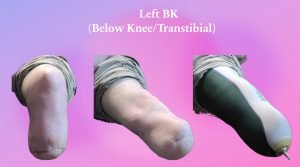
When palpating your residual limb:
Knee Extension without a Liner (Prosthesis Off):
Place your hand gently on your residual limb and feel for even pressure distribution throughout.
Pay attention to any areas of discomfort or excessive pressure points.
This awareness helps you avoid potential issues stemming from an ill-fitting socket and improper alignment of your prosthesis.
Knee Flexion without a Liner (Prosthesis Off):
As you bend your knee, use your fingers to feel the skin and soft tissues of your residual limb stretching.
Note any sensations of discomfort or irritation, which may indicate inadequate support.
Recognizing these sensations prompts proactive measures to enhance comfort and prevent skin issues.
Knee Flexion with a Liner Donned (Prosthesis Off):
Feel for support and stability by palpating your residual limb with the liner in place but without the prosthesis.
Notice how the liner cushions and adheres to the limb, reducing friction and minimizing the risk of skin irritation.
This understanding empowers you to ensure proper liner fit, optimizing comfort during movement.
Knee Extension with a Liner Donned (Prosthesis Off):
With the liner on, extend your residual limb and use your fingertips to check for even pressure distribution.
Pay close attention to any discomfort or pressure points, especially along the edges of the liner.
Being aware of these sensations helps you maintain comfort and prevent potential problems with the prosthetic socket.
Biomechanical Changes of the Tibia and Fibula:
1. Extension: Whether your prosthesis is on or off, during extension, the tibia and fibula typically align parallel to each other, providing stability and support to your residual limb. Understanding these natural alignments helps maintain stability and balance during various activities.
2. Flexion: During flexion, regardless of whether your prosthesis is on or off, the tibia may translate forward slightly, and the fibula may rotate. These adjustments accommodate the changing shape of your residual limb and help adapt to the movement’s biomechanics. Understanding these changes allows for adjustments to prosthetic fit and alignment, ensuring optimal function and comfort during daily activities.
Awareness and understanding of these sensations and biomechanical changes when your prosthesis is off are essential for below-knee amputees like you. They facilitate proactive management strategies, leading to improved comfort, function, and overall satisfaction with your prosthetic device.
By being aware of how your residual limb should feel in full extension, with evenly distributed pressure and no discomfort or excessive pressure points, you can actively monitor and assess the fit of your prosthetic socket. If you notice any deviations from these expected sensations, such as discomfort or uneven pressure, it may indicate improper alignment or fit of your prosthesis.
This awareness empowers you to take proactive measures, such as adjusting the fit of your prosthetic socket or seeking assistance from your Prosthetist to ensure proper socket fit and alignment. By addressing any issues early on, you can avoid potential discomfort, skin irritation, or other complications that may arise from improper alignment or fit of your prosthesis. Ultimately, this awareness plays a crucial role in optimizing comfort, function, and overall satisfaction with your prosthetic device.
Cushion. Protection. Suspension.
Contact your Prosthetist to see what works best for you!
Factors such as trauma, contractures, scars, and the length of the residual limb can significantly affect these biomechanics. Trauma or scarring may limit the range of motion, while contractures can alter the natural alignment of the tibia and fibula, impacting stability and mobility. Additionally, the length of the residual limb influences leverage and force distribution, which are vital considerations for prosthetic fitting and function.
Lynn DeCola, CPO
Lifelong Prosthetics, LLC
Website: Lifelongprosthetics.com
Phone: 941-677-8534
Email: Lynn@lifelongprosthetics.com